The WEIBULL Dr.
Multiple Mode Reliability Model
← Return to Weibull-DR Contact Us Download this page as PDF
MULTIPLE MODE RELIABILITY MODEL — OVERVIEW
The Multiple Mode Reliability Model is one of the most powerful and unique features of Weibull-DR. The software takes data generated from the calculation of each individual failure mode and consolidates it into a single new set of Weibull distribution parameters. The result is that the entire system can be represented with a single relationship — a single Weibull equation — rather than requiring separate treatment of each mode.
Note how closely the System Equivalent Weibull Distribution matches the solved system points, where the products of each reliability at each specified reliability level are individually calculated. This is the hallmark of the routine's accuracy.
This routine would be most useful for modeling large groups of relatively similar pieces of equipment, such as:
- Wind farms
- Oil wells
- Flotillas of ships
- Consumer products
- Buses, battle tanks, fighter jets, passenger planes
- Fleets of over-the-road semi-trucks and trailers
- Rental car fleets
- Large-scale medical product studies
- Military vehicle or equipment reliability inputs into computerized competition models
For those working with MIL-HDBK 217 or similar standard routines, simply set all the Shape Factors to 1.0, offset values to zero, and the Characteristic Life values equal to the individual MTBFs. This routine goes a step further than almost all competing software, in that it also provides confidence limit estimates on each summary.
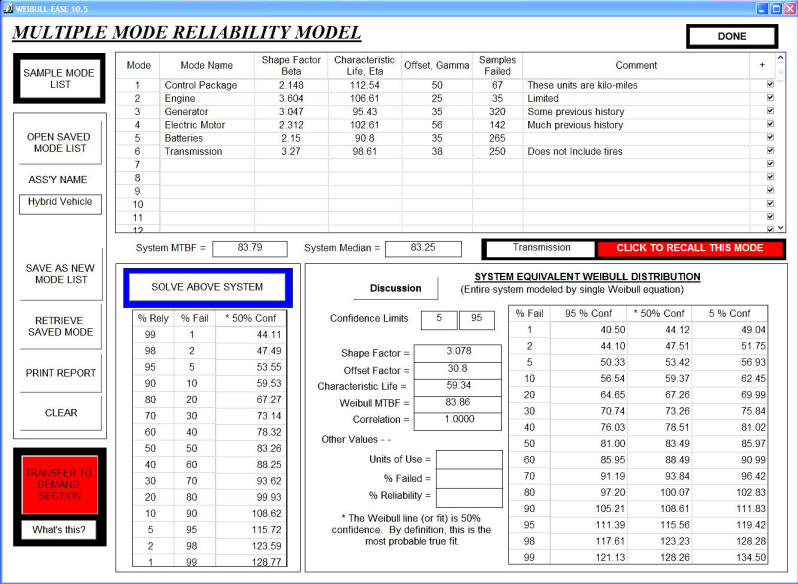
Figure 1. System Equivalent Weibull Distribution vs. individually solved system points.
HOW THE MODEL WORKS
Each failure mode in a system has its own Weibull distribution, characterized by a Shape Factor (β), a Characteristic Life (η), and optionally a Location Parameter (γ). The Multiple Mode routine accepts these individual parameters for as many modes as are present in the system and performs the following steps:
Step 1. For each mode, the reliability Ri(t) is calculated at a series of time points using the standard Weibull reliability equation.
Step 2. The system reliability at each time point is computed as the product of the individual mode reliabilities — Rsys(t) = R1(t) × R2(t) × … × Rn(t) — assuming the modes are statistically independent.
Step 3. A new, single Weibull equation is fitted to the system reliability points computed in Step 2. This produces a System Equivalent Weibull Distributionwith its own β and η values that represent the entire system.
Step 4. Confidence limits are computed and displayed both numerically and graphically on the summary report.
The resulting single equation can then be used directly as input for the Market Use Analysis (Combined Distributions) comparison routine, or treated as a standalone system reliability model.
SAVING AND RECALLING MODE SETS
All failure modes for a given system or machine can be saved together and recalled as a single set. This makes it straightforward to:
- Revisit a prior analysis after new field data becomes available
- Share a complete system model with colleagues
- Use the saved set as input to the Combined Distributions routine
- Compare "before and after" reliability when a design change is made to one mode
The built-in sample data routine demonstrates exactly how saving and recalling a mode set works. It is recommended that new users run through the sample data before entering their own data.
PRACTICAL APPLICATIONS
The following are representative applications of the Multiple Mode Reliability Model:
Future Production Field Reliability Estimates. By combining the Weibull parameters of each known failure mode from prototype or early production testing, an accurate prediction of field reliability for the full production population can be generated before volume production begins.
Fleet Analysis. Analysis of rental car fleets, truck fleets, or any population of identical units in service. Each major failure mode (engine, transmission, brakes, etc.) is characterized separately, then combined into a single fleet reliability model.
Medical Products. Large-scale medical product studies where multiple independent failure mechanisms must each be characterized and then combined to represent the overall device reliability — critical for regulatory submissions and post-market surveillance.
Military Equipment. Military vehicle or equipment reliability inputs into computerized competition or logistics models, where each subsystem's reliability must be combined into an overall mission-reliability figure.
MIL-HDBK 217 Compatibility. For users working within MIL-HDBK 217 or similar standards, set all Shape Factors to 1.0, all offset values to zero, and set each Characteristic Life equal to the corresponding component MTBF. The routine then produces a system-level MTBF equivalent directly from the standard handbook data.
[ Example output image — System Mode Summary Report — to be added ]
Figure 2. Sample System Mode Summary Report with confidence limits.
CONFIDENCE LIMITS ON THE SYSTEM SUMMARY
A distinguishing feature of Weibull-DR's Multiple Mode routine — compared to most competing software — is that confidence limit estimates are included on each system summary. These are displayed both:
- Numerically — discrete reliability/failure values at each selected confidence level
- Graphically — confidence bands plotted on the same page as the system Weibull curve
The confidence level can be changed interactively while observing the graphical and numerical effect in real time. The most commonly used confidence values are included as defaults, and the user may enter any desired value.
[ Example output image — System Weibull Plot with Confidence Bands — to be added ]
Figure 3. System Weibull plot with upper and lower confidence bands.
RELATIONSHIP TO OTHER WEIBULL-DR ROUTINES
The Multiple Mode Reliability Model is designed to work in concert with the other major routines in Weibull-DR:
Bearing Analysis. Standard bearing load/life figures can be converted into Weibull reliability parameters using the Bearing Analysis routine. These parameters can then be inserted directly into the Multiple Mode Analysis as one of the system's failure modes.
Combined Distributions (Market Use Analysis). The system Weibull equation produced by the Multiple Mode routine serves as the Capability input to the Combined Distributions routine, where it is matched against the Demand distribution from market research data to estimate the fraction of the population that will fail in service.
Standard Weibull, Normal, Log-Normal, Exponential Routines. Each individual failure mode's parameters are derived from these standard distribution routines before being entered into the Multiple Mode model.
To try the Multiple Mode Analysis routine, download the WEIBULL-DR 45-DAY DEMO. The demo is a fully armed and completely functional program.
Questions? Call (763) 242-7721 or e-mail [email protected]
← Return to Weibull-DR Applications Research Home Contact Us